This short contribution was originally an Annex in the post on Volcanic winter
Types of volcanic eruptions
Volcanic eruption types range from Hawaiian (quiet eruptions with fluid lava) to Pelean (very violent eruptions accompanied by nuées ardentes and avalanches of explosive lava); Stiegeler, 1976. The nuées ardentes (literally “burning clouds”) are high pressure and high temperature gas and ashflows moving at speeds of up to 100 km/h. They transport large amounts of debris and pose very serious threats. The most violent type of eruption – Pelean – leaves very little chance to escape, burns all living creatures and results in widespread destruction. The Mount Vesuvius eruption that buried Pompei in 79 was of that type. Of course, there is more to worry about today than in the first century, because Mount Vesuvius is very close to Naples (Barnes, 2011). Even a very “orderly” and less populated place (Naples has 3 million inhabitants!) place would be almost impossible to evacuate.
Eruptions are usually accompanied by both lava flows (with local effects, i.e. effects usually within a range of 10 to 100 km) and wider ranging atmospheric phenomena. We all remember the April 2010 eruption of Eyjafjallajökull, which paralized air traffic over part of Europe. Another famous Icelandic eruption occurred during 1783, over 12 km3 of lava and 500 million tonnes of noxious gases were emitted during the Laki Fissure eruption (McGuire, 1997.)
Effects
The local effects of volcanic eruptions can also be devastating, for example, no terrestrial species survived the eruption of Krakatoa on 26 and 27 August 1883. The eruption caused more than 35 000 human victims as a result of the tsunami rather than the volcanic eruption directly (McGuire, 1997).
Effects tend to be relatively local only if the ash is not injected into the upper atmosphere. By way of an example, the 1989 (18 May) Mount St. Helens eruption in Washington State reached Idaho and Montana where large quantities of volcanic ash littered the soil to a depth of 1 m in places.
As shown by the eruption of Etna (Chester, et al., 1985) lava flows have the potential to cause structural damage and will destroy any buildings in their path.
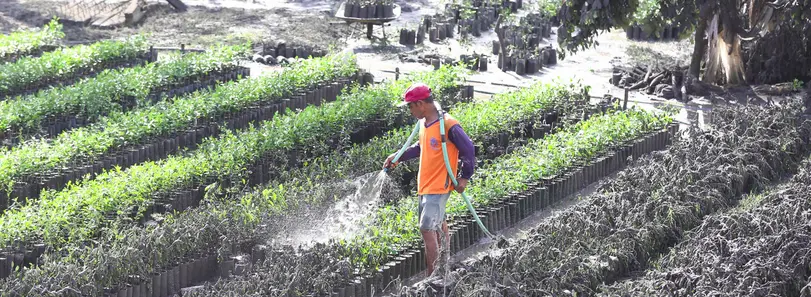
But most important is the fact that prime agricultural land is rapidly “inundated” and can become unsuitable for agriculture and other related activities for hundreds of years. The Pinatubo eruption on Luzon in the Philippines (1991), the largest volcanic eruption of the 20th century, covered villages and agricultural land with sterile ashes, to the extent that around 150 000 people were made homeless and 600000 lost their livelihoods. The ash blanket reached a depth of several metres in the valleys close to the mountain, reducing to an average depth of 5 cm at a radial distance of 40 km. An estimated 5 000 km2 was affected. Some of the most fertile land in the Philippines had to be abandoned, leading to immediate damage and loss of future income. Mudflows created havoc in flat areas up to 50 km from the crater, by, for instance, clogging fishponds. An estimated 326000 ha of forest, 43000 ha of cropland and 16000 ha of ponds were damaged. Even in 1992, mudflows still occurred and buried crops (Rantucci, 1994).
On the positive side, it should be mentioned that where ash does not exceed 10 cm, it can be ploughed in and will increase productivity due to its pH, P, K, Ca and Mg, even if Fe and S are excessive (according to Rantucci). Similarly, Besoain et al., (1992), found the deposits from the Lonquimay volcano in Chile between 1988 and 1990 had improved local soil quality.
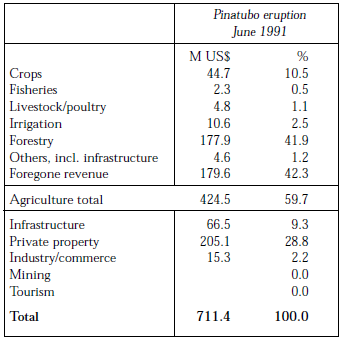
Rantucci provides a detailed breakdown of the total loss incurred to the economy due to the Mount Pinatubo eruption (Table 1). Agriculture accounts for 59.7 per cent of the total economic loss, most of it in the forestry sector and in the form of lost revenue.
Finally, a special mention should be made of the 1986 (21–24 August) “eruption” of Lake Nyos (north-west Cameroon) which was characterized by major CO2 and H2S emissions (Youxue Zhang, 1996). The toxic mixture caused about 3000 deaths and in Nyos village only 2 of a population of 700 survived. Poultry and cattle experienced heavy losses.
References
Barnes, K. 2011. Europes ticking time bomb. Vesuvius is one of the most dangerous volcanoes in the world — but scientists and the civil authorities can’t agree on how to prepare for a future eruption. Nature, 473: 140-141.
Besoain, M.E., Spulveda, W.G. and Sadzawka, R.A., 1992: La erupcion del volcan Lonquimay y sus efectos en la agricoltura. Agricultura Technica (Santiago), 52(4):354–358.
Chester, D.K., Duncan, A.M., Guest, J.E. and Kilburn, C.R.J., 1985: Mount Etna, the anatomy of a volcano. Chapman and Hall, London. 404 pp.
Gommes, R. 2003. Specification for a database of extreme agrometeorological events, Chapter 8 in pp. 123-134 in H.P. Das, T.I. Adamenko, K.A. Anaman, R.A. Gommes and G. Johnson, 2003, Agrometeorology related to extreme events. WMO Technical Note No.201 (WMO-No.943), WMO, Geneva, 137 pp. http://library.wmo.int/opac/index.php?lvl=notice_display&id=7915
McGuire, W.J., 1997: Volcanic disasters. Past, present, future. Science Progress, 80(1):83–99.
Rantucci, G., 1994: Geological disasters in the Philippines, the July 1990 earthquake and the June 1991 eruption of Mount Pinatubo. Italian Ministry of Foreign Affairs, Directorate General for Development Cooperation, Rome, Italy, 154 pp.
Stiegeler, S.E., 1976: A dictionary of earth sciences. Macmillan Press, London, 301 pp.
Youxue Zhang, 1996: Dynamic of CO2-driven lake eruptions. Nature, 379:57–59.