The post examines some issues related to internet “democracy” and “freedom”, and how the choice of a good browser can somewhat protect your privacy.
This is seen in the broader context of our freedoms in general, which are a fundamental component of the quality of our lives. They are being eroded inexorably, in the wake of the growing End of Times Fascism described by Naomi Klein and Astra Taylor, or Sarah Wilson1. With or without AI, we are headed for less individual freedoms, more inaction about climate change and environmental degradation, more extremely rich mega-rich people thriving on our data, less solidarity and, generally, a proliferation of autocrats.
The first part examines the current situation of global Internet Freedom. The second focuses on the techniques used by the internet blood suckers (mainly Google, Apple, Facebook and Meta, Amazon, Microsoft and other Big Tech companies) to access our personal data, with our knowing or unknowing consent. The third has a look at what we can do to protect our privacy, albeit minimally by the use of adequate browsing tools.
1. Internet freedom
I recently came across the Her Justice website, which assists women and gender diverse people living in poverty in New York City who have legal needs in the areas of family, divorce, and immigration law (quoted from the website). It is sad enough that there should be specific websites to assist women and gender diverse people living in poverty in New York, but what I found particularly appalling is that Her Justice has a page entitled Cover your tracks online. In the Country of Freedom and the World Champions of Democracy2, you now have to cover you tracks when you seek assistance for anything that has a gender or race component. Because the man currently in charge is the enemy of otherness, diversity, empathy and humanity. In the US, it has now become risky to show your non-conformity!
The surveillance of the internet has become endemic and systematic. Refer to Computer and network surveillance in Wikipedia for details. In the US, institutional surveillance is mainly carried out by Information Awareness Office under DARPA, NSA, and the FBI. For a somewhat more sober presentation of the Agencies with less self congratulatory material than their homepages, prefer the Wikipedia entries: Information Awareness Office, DARPA, NSA and FBI.
It seems that Internet Surveillance is less pervasive in Europe, according to Wikipedia. I have, however, little confidence in the un-elected European Commission (EC) currently headed by German’s former defence minister, Mrs von der Leyen, a member of the German “centre-right” CDU. Members of the EC are nominated by their countries and must be approved by the elected Parliament. There is little doubt that, once approved, the EC largely follows its own agenda and that is open to pressure from lobbies and commercial interests3. The EC may issue rules, often very un-democratically, but individual countries can eventually bypass them!
This obviously applies to internet surveillance. Several countries have introduced creeping internet surveillance, e.g. Germany, and surveillance is quietly becoming the norm. Hypocrisy is the norm4 too. There’s a lot of talk about the preservation of the right to privacy and freedom of expression, but in practice those rights are weighted against traditional perceived risks and the necessity to monitor alleged political and common-law offenders, especially child protection.
Altogether, while I profoundly dislike the undemocratic and right-wing European Executive, I admit that we are still far from the level of surveillance that prevails in the US and in the countries of some other autocrats, especially China. Cloudwards has recently (2026) conducted a global survey of Internet freedom by country (Figure 1)5.
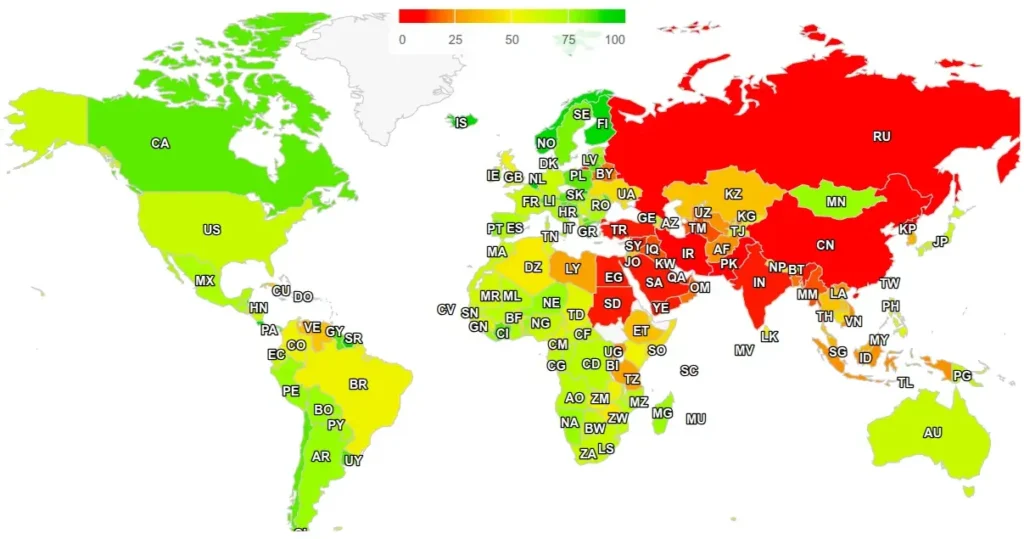
The highest score (92) is achieved by Belgium, Costa Rica, a group of “Nordic” countries (Denmark, Finland, Iceland, Norway), Liechtenstein, New Zealand, Slovakia, Suriname and Timor-Leste. Germany, France and the US score 64, the same level as Morocco, Japan and South-Africa. The United Kingdom6 unsurprisingly appears with Colombia, Kenya, Kyrgyzstan and Zambia at 52. Israel and Ukraine are at 44; Egypt, India, Türkiye and Saudi Arabia reach 12 while a group of friends (Russia, China, Pakistan and Iran) sit at 4, just above their other friend, North Korea, which is simmering at 0 as the only country in this category.
I find it particulalerly interesting that in the middle of the worst internet censorship ocean (China, India, Sudan to Russia) we have an island of freedom with Kazakhstan, Kyrgyzstan, Uzebkistan and especially Mongolia!). See post in Times of Central Asia.
2. Finger printing and mass surveillance by the Big tech companies that dominate the internet
When we access the internet, our browser communicates with the sites we visit and exchanges some essential information that is needed to make the connection work. For instance, based on my IP address, some sites decide that I am based in Slovenia7 and automatically propose a Slovenian-language version of the site I am trying to look up, and will also target me with Slovenian adverts! Problems may arise if the site I visit finds my Slovenian IP (93.115.0.21) but also detects that my time is set to UTC-7, corresponding to Hermosillo or Tijuana in Mexico. In addition, I may use the Bengali version of Firefox in my Georgian version of Linux Mint. I may also use a Belgian Keyboard because that’s what I grew up with.
I said “problems may arise” because the situation I described may seem confusing to a normal human, but such an extraordinary configuration also makes me very weird and very unique, which is the same as saying “immediately identifiable”. The collection of features that identify my browser are know as my Browser fingerprint. When visiting the internet, the best approach is to be as grey as the rest of us8. This is the approach adopted by the browser developed by the TOR project, the browser used by Edward Snowden9: all Tor users should have the exact same fingerprint. No matter what device or operating system you are using, your browser fingerprint should be the same as any device running the Tor Browser (refer to Browser Fingerprinting in the TOR Blog). Some of the more sophisticated browsers can even randomly modify your fingerprint at random time intervals!
One of the best documents on how internet surveillance works was published by the Electronic Frontier Foundation, EFF: Behind the One-Way Mirror: A Deep Dive Into the Technology of Corporate Surveillance10. But the recent trends we have seen – notably the criminalisation of support for Palestine, mostly in the US and the UK – combined with the rise of far-right movements, globally and particularly in Silicon Valley, is giving governments more and more excuses to curtail our individual freedoms. We may feel relatively safe in Europe, but it is only a matter of time before our “democratic” governments succumb to the allure of fascism. Interested readers may find this July 2026 article from Indiavision interesting: A Majority of European Lawmakers Voted Against Letting Big Tech Read Our Messages. They’re Going to Anyway11 .
We are thus monitored by governments under a whole collection of more or less realistic motivations, but the bulk of surveillance is operated by private companies. Why are Google applications so good that they are ubiquitous and that it is virtually impossible to avoid them all. Why does everyone have a Gmail account? A Twitter (now X) account? Why can I not pay my Guardian subscription without using a Google application? Because it is easier and certainly much cheaper for The Guardian to avail itself of a no-doubt very professional ad hoc application developed by Google! Of course, in the process, I have to prove my credentials: identify myself by name, provide my credit card details and, the icing on the cake, give Google my phone number so that they can better “double check my ID” to protect me12 and prevent some random – and, certainly, malicious – individual from impersonating me and paying my Guardian subscription on my behalf!
Read Behind the One-Way Mirror! It will make you understand that the internet sharks (Google, Microsoft etc.) are not just building anonymous databases for better targeting advertisements or, maybe, for statistical purposes (remember the Facebook–Cambridge Analytica data scandal!). No, what they want is your name, the name of your wife, your sexual preferences, your age and address, the names of your children and the brand of your preferred beer, and which political party you vote for.
3. Some browsers assessed
In fact, there is not much we can do. When we use the web we lose our privacy. As simple as that. There are some elementary precautions we can take, for instance accessing the internet through a Virtual Private Network (VPN) which prevents your internet provider and your government from monitoring the contents of your internet traffic: you access a server (in your country or elsewhere) through an encrypted connection and your IP appears to be that of the server13.
This does not hide your browser’s fingerprint to the sites you access. But some browsers are better than others. The least we can do is to use a Browser that gives as little information away as possible.
The EFF has published a tool known as Panopticlick, currently in Version 3.0. As with their excellent Behind the One-Way Mirror! report, Panopticlick is several years old (it was issued in 2017!) and I eagerly await their update!
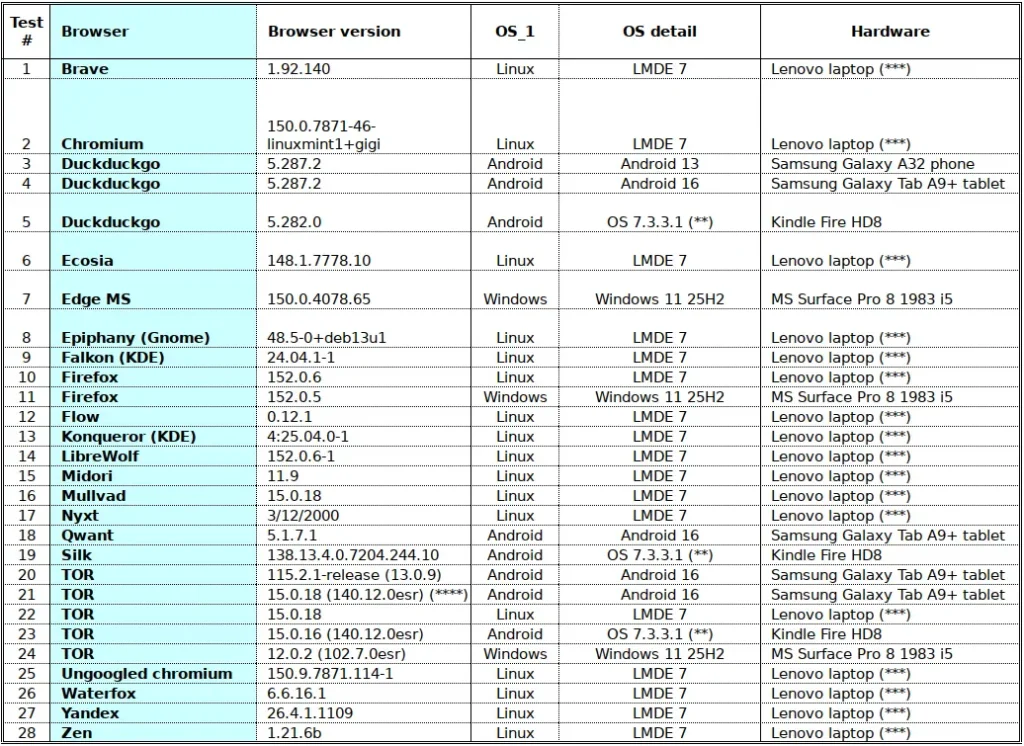
In Table 1 below I have assessed 28 different instances of Browsers that are easily accessible to me, mostly on Linux and Android. The table in the Annex lists the exact conditions of the tests the results of which are given in Table 1.
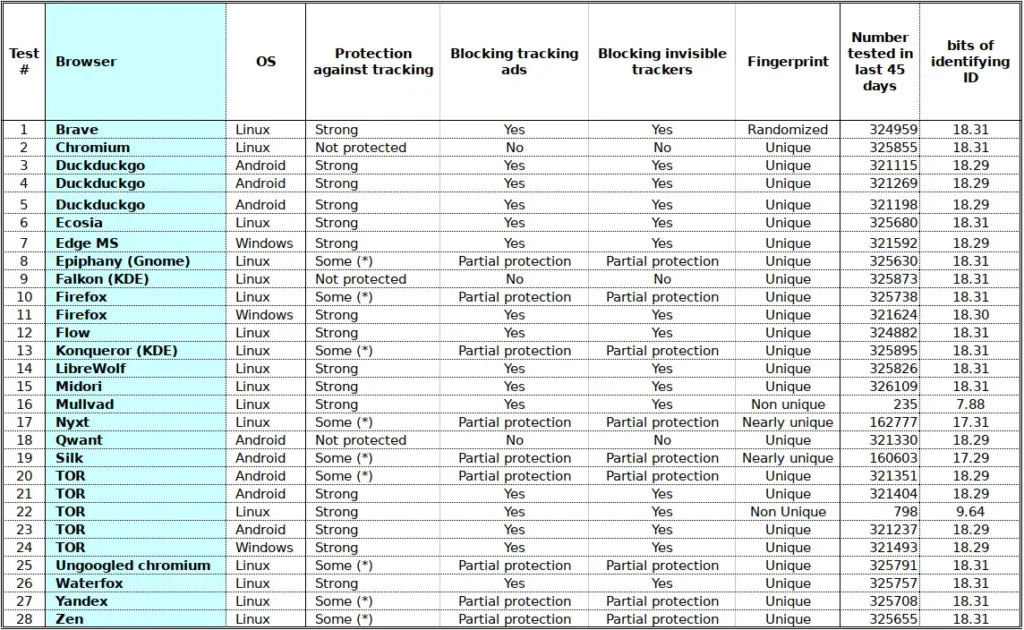
There are many companies that track you, directly and indirectly, by depositing various types of cookies on your computer. Some of those cookies are “legitimate” for instance if you want your computer to remember that you prefer to browse the site of your bank with a yellow background, or to automatically express temperatures in °C or Fahrenheit. Many Companies (e.g. your bank!) also make some extra money by depositing so called “third party” cookies, which are managed by specialised companies who sell the information they collect to advertisers or to more obscure and sinister agents, e.g. to profile you politically or to influence elections.
In table 1 above it appears that Brave, TOR and the Mullvad browser (which Mullvad develops jointly with TOR) offers an excellent level of protection. Unfortunately, the Mullvad browser rather poorly handles some situations where there is a perceived risk, as with websites embedded in other websites (e.g. my weather data embedded in Wergosum.com). This has been a problem at least since 2023 and, clearly, constitutes an obstacle to the wider adoption of the Mullvad Browser. TOR offers excellent privacy but tends to be somewhat slow because it hops over thousands of relays run by volunteers and millions of users worldwide. And it is this diversity that keeps Tor users safe (This link). In practice, it seems that the Brave browser is the unanimous best choice for everyday use (see PCMag, ZDNet, iTechGuides, TechPuts, and BroadBandSearch). There are
Brave is the best, but estimates of global browser use lists the following as the leaders: Chrome (Google, about 60% of installed browsers14), Safari (Apple and MacOS, about 20%), Edge (Microsoft, about 10%) and Firefox (Mozilla, about 5%). The percentages vary according to the platform (PC, tablet, phone). Google, Apple and Microsoft are not the best, but they are the richest15.
Most current browsers in Table 1 are somehow based on Firefox or Chrome. The first family largely inherits the problems that may affect Firefox, which they all tweak, simplify, expand… Chrome, on the other hand, is one of the numerous offspring of Google. In fact, Firefox was introduced in 2002 and peaked at about 30% around 2010. Since then, its share have been continuously eroded by Chrome/Google. CLRN provides a good overview of what has initially made the success of Firefox and the differences with Chrome. It is probably difficult to assess the intrinsic technical merits of the Firefox-approach Vs. the Chrome-approach, but there is little doubt that the power of Google is the main factor behind the success of its browser. This, in my view, is in itself a sufficient reason to avoid Chrome and chrome-based browsers16.
Note, however, that the browser market is huge. According to Mobiletracker.com, there were just under 3 billion computers in the world in 2022, not to mention tablets and mobile phones. Each device has at least one browser installed. This is to say that even a tiny share of the market may still represent a huge number of browsers. This explains while the browser market is so crowded and the survival of near-confidential browser (Vivaldi, Opera) as well as companies trying their luck, as happened recently with the browser introduced by Duckduckgo.
Conclusions
Whether we like it or not, whenever we access the internet we implicitly expose ourselves to being monitored. We have no reason to assume that the government or commercial entities monitoring us are benevolent. On the contrary, we have every reason to believe that the motivations of those monitoring us are, first and foremost, commercial, but increasingly political as well. Immense fortunes have been amassed by the internet giants, and we are seeing more and more clearly that the super-rich are openly pursuing an anti-democratic agenda. It is more than legitimate, within the limited means at our disposal, to resist these bloodsuckers17.
Annex
Notes
- Your worst fears about cultural collapse might be true – here’s what you can do about it, by Sarah Wilson. Interview in The Guardian. ↩︎
- Vietnam, Afghanistan, Iraq… were all somehow justified by the need to “impose democracy”. I like this perfectly hypocritical text by Zbigniew Brzezinski. Brzezinski explicitly considered that chaos in the countries of the “enemies” of the US is good for the US. This is one of the sources of the current middle-eastern nightmare and, as far as I can judge, has reached a stage which is completely out of the control of the autocrats who pretend they are in control. Their method is “bombing” and no empathy and is unlikely to bring lasting geopolitical benefits. ↩︎
- This is very visible, for instance, in the list of a number of contested pesticides which the EC has endorsed for use in the EU. Not later than a couple of days ago, the French government has lifted the ban on Acetamiprid. ↩︎
- In 2021 it was revealed that – using the Israeli designed Pegasus application – the Moroccan government had been spying on French journalists and politicians, including President Macron. This was recently confirmed by a Moroccan intelligence insider. In 2021, I would have expected a generalised barrage of indignation à la française, French diplomats leaving a meeting in single file and maybe even broken diplomatic relations. Instead, nothing visible happened. The reason being, quite obviously, that the French too had been spying on their Moroccan brothers, maybe even on the local autocrat himself Mohammed VI, and half his government! Quite obviously using the same Pegasus software from the same source! Here is another example of hypocrisy, nicely summarized by the title of a an early July 2026 article in Indiavision: A Majority of European Lawmakers Voted Against Letting Big Tech Read Our Messages. Theyre Going to Anyway ↩︎
- The authors are Kit Copson and Sandra Pattison. ↩︎
- Just consider the treatment of the activists of Extinction rebellion and the Palestine action… ↩︎
- In reality, I use a Virtual Private Network (VPN), which is to say that the websites I visit see me as if I were somewhere else. My computer (and my tablets, and my phone…) connect over a secured line to a server based in my country or another country. Of course, apart from my IP, most other details of my fingerprint do not change regardless whether I access a site via Slovenia or via Albania. ↩︎
- No, I am not suggesting that you switch to Windows! ↩︎
- Snowden also used a privacy oriented brand of Linux distribution known as Tails. There are now more options next to Tails than at the time when Edward Snowden was on the run in 2013. According to Wikipedia, the US National Security Agency allegedly monitors people who download Tails. In 2024 the Tails Project merged with the TOR Project. See Uniting for Internet Freedom: Tor Project & Tails Join Forces on the Tor Blog. ↩︎
- The authors are Bennett Cyphers and Gennie Gebhart. Unfortunately, the document was published back in 2019 and would now need a serious update! ↩︎
- The original article appeared in Wired, but I cannot access it. ↩︎
- We value your privacy, they say! ↩︎
- Right now, my IP address is 154.47.16.46 in Bogotá, Colombia (111411)! ↩︎
- This is a global phenomenon. Ten years ago, Firefox clearly dominated in Europe and parts of Africa. ↩︎
- They thrive mostly on their customers’ ignorance. When you have a minute, re-read La Fontaine’s The Wolf and the lamb. Also remember the Internet Explorer (IE) saga: Microsoft initially bundled IE with Windows in the 1990s. ↩︎
- There are other interesting cases of de-googled applications next to “ungoogled chromium“. For instance, the Kindle runs a variant of Android (Fire OS) that was de-googled by Amazon. The corresponding AppStore pays money to Amazon rather than Google. Logically, Silk, the Kindle browser is based on Chromium. There are some other cases. Blackberry 10, was the OS of the (discontinued) Blackberry phones. Just like Fire OS, it used to be a de-googled version of Android. ↩︎
- That most ultra-rich are now openly anti-democratic has become very obvious with the crowd of Trump worshippers such as Musk, Thiel, Bezos, Zuckerman… Refer to Quinn Slobodian’s Crack-Up Capitalism (2023) and Free-Market Idolatry and Hatred of Democracy Go Hand in Hand. ↩︎