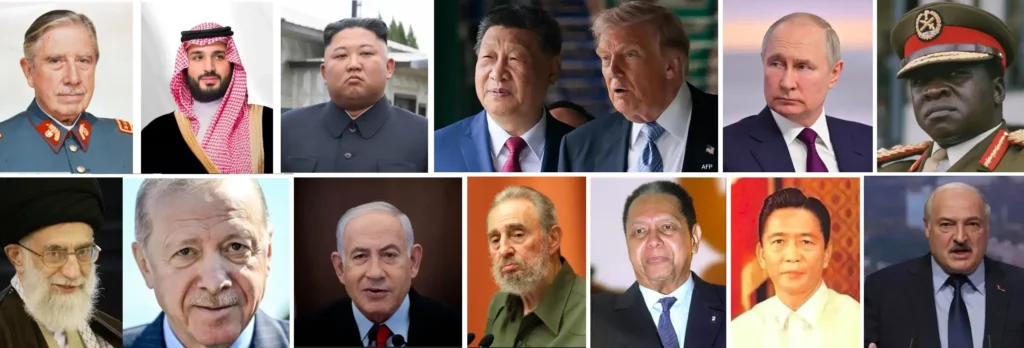
Who controls the past controls the future; who controls the present controls the past (1984 Fidesz party slogan).
Introduction
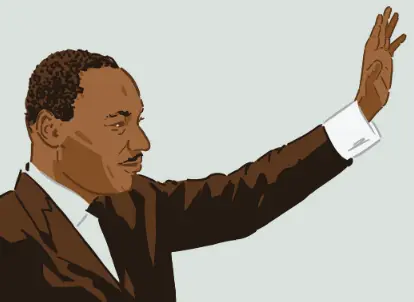
This post is about autocrats and about some of their tricks and symbols of power, starting with statues with an outstretched right arm. The gesture is usually intended to be fatherly and reassuring, and often serves as a welcoming greeting (Figure 1). It has been adopted by many major and lesser autocrats to show their love for their people, including Kim Il-sung, Lenin, Mao Zedong and Saddam Hussein. The message of the raised arm may, however change if the fingers are clenched into a fist or the hand is holding an object.

It has happened too, occasionally, that the benevolent ruler abuses his subjects’ devotion to him and loses their love. There is indeed often a process of decline when leaders cross over to ‘the dark side of the Force’, when their paranoia gets the better of them, when the populace eventually grows weary of the wars and bloodshed triggered by the leader’s egomania, insatiable thirst for power, senility or… simply an intellect that is not a match for the good father’s ambition.
Making history
Simon Tisdall’s recently wrote an article suggesting that Trump, Netanyahu and Putin’s powers appear to be waning2. It does not seem that any of them is of the Good fatherly type3, but clearly, together with some other autocrats (Xi and, to some unknown extent some lesser autocrats like Kim Jong-un and Erdogan4) they are making history. Admittedly, history is constantly being made and unmade but sometimes it accelerates and currently it shows no signs of slowing down. Although the modern trend of teaching history in Europe has moved away from the “history of Kings and wars” to focus on the “life of ordinary people”, what we see happening is a situation pregnant with a large potential of escalation: Greenland, Bolivia, Cuba, Türkiye5… This is driven by the kings of the moment, their short memories and lack of empathy. Ordinary people just suffer and try to survive.
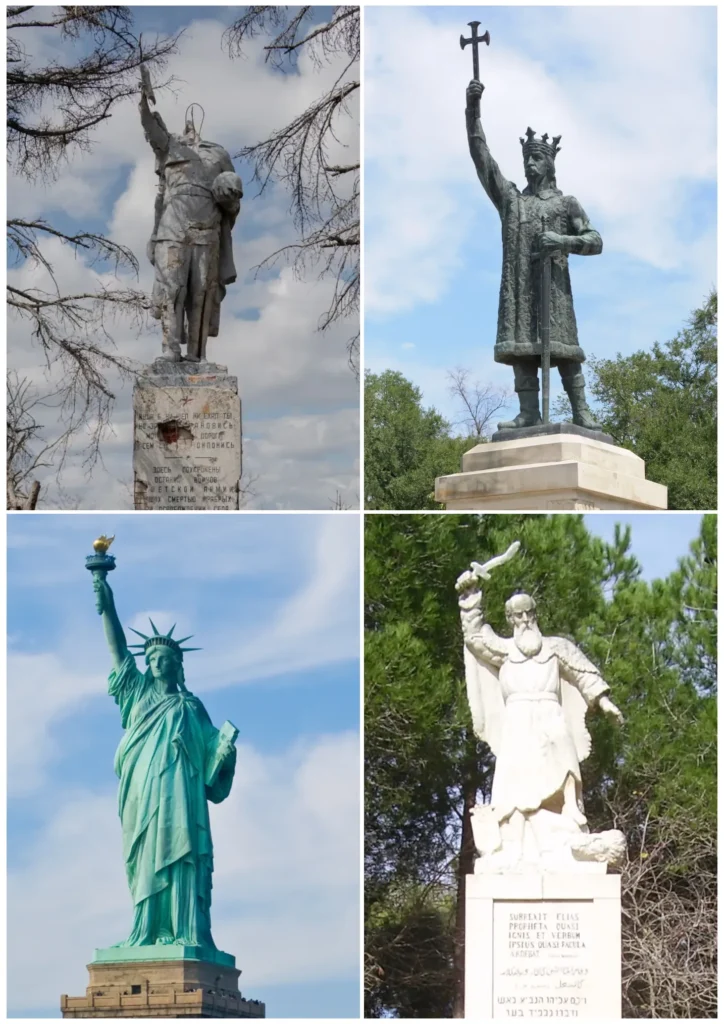
There is a quote attributed to Paul Valéry which says that War is a massacre of people who don’t know each other, for the profit of people who know each other, but don’t massacre each other. Valéry applied this sentence to the Franco-German wars but it certainly also applies to the current Russia-Ukraine war! In fact, this post was triggered by a photograph in The guardian showing the damaged Monument to a Soviet soldier in the Ukrainian village of Dovhenke (see Figure 2 below). If I examine this rationally, I wonder why the monument was targeted. Even if I can understand that Ukrainians nowadays dislike anything Russian, the statue represents a Soviet soldier, a group which includes the grand-fathers of many Ukrainians soldiers.
The posture of this headless and bullet-ridden soldier reminded me of the very similar posture of the monument to Stephen the Great in Chisinau, in neighbouring Moldova. Transnistria in Moldova is an uncontrolled region6 that has whetted Russia’s territorial ambitions. If things come to the worse, poor Stephen may well lose his head like the Dovhenke Soviet soldier!
Full-length fatherly statue with the right arm outstretched
Next to the Soviet soldier and Stephen the Great, Figure 2 represents some additional statues representing people in similar positions. Let us skip the infamous Nazi salute and move directly to one of the best known statues in the world, New-York’s Statue of Liberty which symbolizes the light of freedom and used to welcome arriving immigrants who eventually contributed to the greatness of the pre-Trump USA. In a more bellicose mood, the next photograph shows Prophet Elijah (Mukhraka Carmelite monastery, Israel) holding a sword. Elijah is shown while he prepares to slaughter a priest of Baal7 (refer to Wikipedia for the whole story).
In addition to the Good fathers mentioned in the first paragraph and the statues in Figure 2, there is an inexhaustible supply of full-length statues raising their right arm… We even have Trump, who, true to the only god he believes in next to himself (i.e. money) holds a bitcoin at the end of his outstretched arm in one of his statues. There is another Trump statue made of bronze – subsequently guilded8 – standing at Doran Golf resort9.
Symbols
All statues carry a message and each of them is a conscious or sometimes inconscious attempt to influence the historical narrative10. The Green European Journal has a most revealing article about Owning the Past: Orbán’s Statue Craze. The article estimates that between 2016 and 2025, more than 2000 memorials and statues have been erected/modified/demolished to bend history to suit Orban’s vision11. We’ve had denazification12 in Germany, de-stalinization in the Soviet Union, de-ba’athification13in Iraq; now we have de-viktor-orbànification14 in Hungary. Putin seems to be relatively immune: there’s no shortage of monuments stating Putin’s truth, but there do not appear to be many statues of Putin himself. What about Netanyahu? Statues have appeared here and there, but they were erected by opponents to deride him (See Times of Israel and Jewish News). It thus appears that all autocrats are not equally egomaniacal.
The pitiful demise of certain autocrats
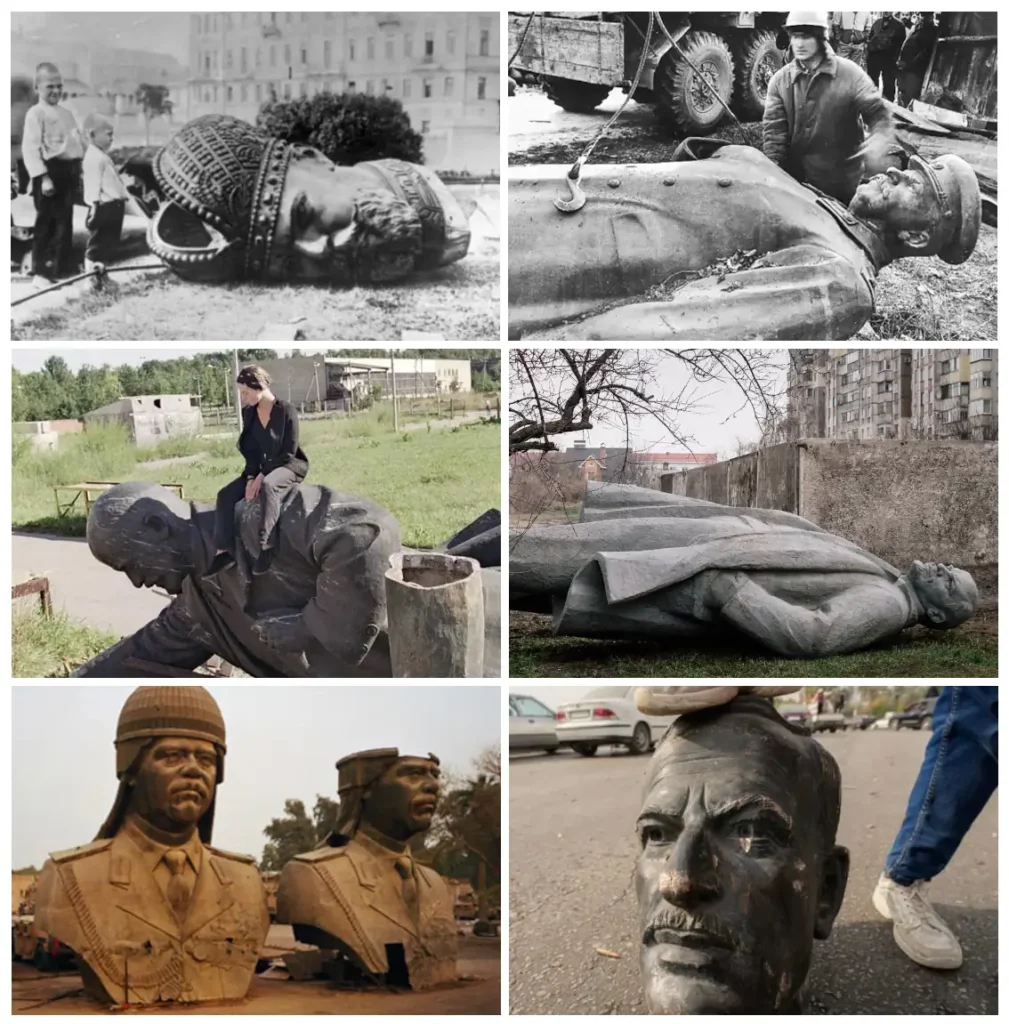
Fortunately, autocrats inevitably reach the end of their reign one day, whether willingly or by force. If they have failed to secure a successor, their legacy and their regime are often subjected to intense efforts to delegitimize them15. This was practiced in antiquity (Egypt, Rome) and continues to this day. The statue of Alexander III, a very unpopular emperor of Russia was toppled in 1918 during the Revolution. Figure 3 shows the head of a statue of Alexander III as well as other demolished statues of dictators.
During the Hungarian revolution in 1956, the statue of Staline (who was in office until 1952) was the immediate target of the liberation movement. Iraqis and Syrians lost no time to demolish the statues of Saddam Hussein and those of Hafez el Assad immediately after the end of their regime16. The same happened to many symbols of the Soviet regime when the former Soviet republics accessed independence. In Ukraine alone, there were an estimated 5500 statues of Lenine.
To conclude
Autocrats come in several flavours. Many like to be loved and admired. To do so, they need to weave a myth of growing complexity which the ordinary people can believe and admire (Read How China guards the Xi creation myth or Ben Reiff’s recent article about Israel in The Guardian). Staline liked to be known as the “Father of Nations”, “Builder of Socialism”, “Architect of Communism” when it was not the more ambitious “Leader of Progressive Humanity”17.
Fatherly dictators and the correlated fatherly statues seem to be somewhat out of fashion. Instead, we have the type who disregards rules of democracy and gradually grows more and more authoritarian, jailing and killing opponents and severely restricting elementary freedoms, including the freedom of the press. There is only one truth and that truth is their truth. This group includes individuals who are extremely cruel and completely lack empathy; they are supported by a significant portion of their population (Netanyahu) who kill perceived enemies with impunity, with the tacit support of their government. It is extremely ironic and hypocritical when the Israeli army allegedly sanctions soldiers who beheaded a crucifix in Lebanon. Chopping off a piece of wood is punishable; shooting a doctor or a hungry child is not18.
Autocrats’ symbols are everywhere, and in most countries “alternative truths” are imposed on people. Statues are not the only trick. They can conveniently be replaced by a museum, a stadium, a Triumphal Arch, an airport, a White house ballroom19 or a signature on 100 $ bills. The legitimacy of todays dictators is established through their control of information and the modification of history.
Autocrats eventually die or get ousted. The nature of their control, however, is such that de-netanyahusation and de-trumpisation will be considerably more difficult than toppling some statues and executing the dictator’s aging friends. This is because of their very polarizing effect on their societies. Somehow, my feeling is that de-Xification and de-Putinisation will be relatively easier. All autocrats resort to a combination of coercion and brainwashing, of which the second will be difficult to eradicate. Even if coercion, especially physical violence, leave traces, post-traumatic stress will probably fade away faster than deleterious ideology, such as fundamental Christianity, nationalism, systematic disinformation and conspiracy theories.
Notes
- Featured image: Martin Luther King. Source of the featured image: Pinterest. ↩︎
- It may not feel like it, but hope is on the horizon: Trump, Netanyahu and Putin’s powers appear to be waning. The Guardian. ↩︎
- Still, sometimes there are surprises, as in this post where Netanyahu is full of concern for the Christians serving in the Israeli armed forces. ↩︎
- I am confining this post to the current-day dictators. Including historical ones such as Idi Amin or Menghistu Haile Maraiam would considerably extend the list. Refer to Frank Dikötter’s How to be a dictator (2019). No two dictators are the same but they have things in common. For instance personality cult. Or the fact that their beginnings were often modest, even genuinely serving the people, like Papa Doc Duvalier in Haiti. The authoritarian drift comes later, and may include cruelty and no mercy for opponents. Paranoia and delusions of grandeur are part of the package too. ↩︎
- According to Haaretz and AlJazeera Türkiye is seen by Israel as the next threat after Iran. ↩︎
- Next to the eastern regions in Ukraine, we also have Abkhazia in Georgia and South Ossetia. Both are “independent” and “supported” by Russia. This is all part of the historical geopolitical nightmare of the Caucasus and I have no difficulty understanding that Russia may feel threatened by the ongoing expansion of NATO and the EC to the east. It remains that different parts of Ukraine have been undergoing endless political re-arrangements. See this link for a narrative. A historical map of border changes in Ukraine is available here. As an eastern Belgian born in the former Prussian Wallonia, I can understand what moving borders do to the people’s loyalty. I am all the more impressed by Ukrainian “nationalism” when regions like Crimea became “Ukrainian as late as 1954”. ↩︎
- I have always had a soft spot for Baal, ever since reading Salammbô as a teenager. The liking encompassed Carthago and Hannibal. I never understood why Carthago had to be destroyed. In fact, I was subjected to a typical form of indoctrination at school: the Romans were the good ones, and the enemy of the Romans were the bad ones. No-one told us that Caesar (a century and more later than the Punic wars) was driven solely by greed and his thirst for power. When he conquered Gaul in the first century BC, he killed one third of the population, and sold another third as slaves to fund his wars and his ambition. Instead, we were told at school he brought us Civilisation. Although it is difficult to compare antiquity with modern situations, it is clear that Caesar’s wars brought about profound changes in the Gallic society. Just bombing countries is unlikely to achieve similar results. In Gaza, however, it is likely that the death toll is close to 10% (See World population review for population numbers, Wikipedia for casualties), still far off Caesar’s 33%. Maybe the fanciful Gaza strip take-over project hatched by the twisted minds of Trump’s team will succeed where Netanyahu’s brute force has failed? ↩︎
- It seems that Kitsch is a European concept. Someone may find it amusing that “tacky”, a near synonym of kitsch, sounds like TACO. ↩︎
- The link tells us that the sculptor, Alan Cottrill, received $300,000 for the bronze work and $60,000 for gold leafing. Naturally, the statue is a private initiative that will not be funded by taxpayer money but by the Presidents wealthy friends and admirers. Needless to say, only ill-intentioned people might think that this is a way for the mentioned wealthy friends and admirers to buy favours… ↩︎
- Let me mention the recent crusade (a dangerous word) against colonial and confederate monuments and statues! The “historical narrative” (read: Brainwashing) may also have been part of the obscure motivation of the soldiers behind the desacration of Christian statues in Lebanon. The international press has widely shared the photograph of an Israeli soldier axing off the wooden head of a fallen crucifix. Maybe the low-IQ soldier did not really grasp the difference between one enemy and another, the difference between his narrow world of IDF operations and geopolitics? He obviously was unaware that harming a symbol of Christianity carries the risk of alienating some essential support of US Christian Zionists. ↩︎
- Orban rebuilt several buildings of Horthy times (1919-1945) in the Castle of Budapest to use as ministries, at great expense. He also undertook a politically relatively neutral but nevertheles nationalistic rehistoricization of Budapest. As to statues erected during the “socialist” period before 1990, they were relocated for didactic purposes to the Budapest Mementopark. It must be stressed that many of Orban’s monuments had essentially a nationalistic component, such as monuments to people who died during WWII: they were heroes who died for their country. ↩︎
- The Wikipedia article starts as follows: Denazification (German: Entnazifizierung) was an Allied initiative to rid German and Austrian society, culture, press, economy, judiciary, and politics of the Nazi ideology following the Second World War. ↩︎
- The second sentence of the Wikipedia article reads It (i.e. De-Ba’athification) […] was considered by the CPA (i.e. Coalition Provisional Authority) to be Ba’athist Iraq’s equivalent to Nazi Germany’s denazification after World War II. ↩︎
- Although I found only one occurrence of the word, the phenomenon is clearly taking place… and will take a decade or longer. ↩︎
- Even when they designate and establish a successor, things may go wrong (as in the case of Spain). ↩︎
- In Iraq, this was orchestrated and publicized by the “Coalition”: no doubt another of their great military victories over terrorism. ↩︎
- Consult Joseph Stalin’s cult of personality in Wikipedia. ↩︎
- Talking of hypocrisy, I cannot help mentioning the recent indignation of the Western rulers after the publication, by a proud Ben-Gvir himself, of a video showing his taunting of the kneeling “prisoners” of the Gaza aid flotilla. Some of the activists were allegedly beaten, raped etc, but this is nothing new. It has been BAU in Israel for some time (refer to the excellent article in The guardian by Ben Reiff of +972 Magazine). Killing and starving Gazans is perfectly fine, but mistreating western nationals is not. Since when has been deadling with the Israeli snake been a problem? Are Western governments not aware that Ben-Gvir (with his ideology) has been a mainstay of Netanyahu’s coalition since 2022? ↩︎
- Do read the (official) post. It can serve as an illustration of how autocrats create alternative truths. ↩︎

Il faut regarder le film iranien « The devil does not exist » : je le trouve extraordinaire et très perturbant. Il illustre parfaitement la « banalité du Mal » décrite par Hannah Arendt : Netanyahu a réussi à faire cette transformation envers les Palestiniens. Il me semble que c’est un ingrédient essentiel des autocrates afin de commettre leurs horreurs.
Oui, ce film de Mohammad Rasoulof, composé de quatre récits en 143 minutes, est remarquable et perturbant en effet.
Il est disponible sur Arte.tv jusqu’au 30/06/2026: https://www.arte.tv/fr/videos/095080-000-A/le-diable-n-existe-pas/ .
J’ai toujours admiré que les autocrates puissent se décorer de noms ‘sublimes’ comme ‘Génie des Carpathes’ etc etc. sans rigoler, ni être gênés par leur propre bêtise affichée en grande pompe.
Génie des Carpathes: selon Wikipedia, Nicolae Ceaușescu s’est effectivement affublé lui-même de ce titre. Il y en a un autre, que je ne connaissais; Danube de la pensée. En plus de Conducător, comme Mussolini (duce), Hitler (Führer) et le lider maximo de Fidel et de Noriega. Trump, quant à lui, se contente d’être un very stable genius. Voir aussi Caudillo, titre de Franco.
« Le fascisme, ça commence avec les fous, ça se réalise grâce aux salauds et ça continue à cause des cons. »
Henry de Montherlant
La troisième étape est renforcée par tout ceux qui se croient du bon côté du manche, et se sentent ‘augmentés’ de faire partie du courant dominant, et tant pis pour les autres (classique, avec de petits sans-grades frustrés on fait de très bons capos).
Toute révérence due, votre Honneur : Xi Jinping est né le 15 juin 1953, ce qui signifie qu’il aura 73 ans en 2026.
Mais où avais-je la tête? J’ai immédiatement rectifié.