The Guardian have asked about 150 English-language authors to provide a ranked list of their 10 preferred books; not just the books they happen to prefer, but their perceived “best” books. What the Guardian was after is the identification of the greatest literature1 available in English. The Guardian has then turned this into the The 100 best novels of all time2.
The Guardian’s list and other lists
Needless to say, the Guardian’s list is not the first of its kind. Here is a French Top 60 as well as a French Top 100. The Spiegel has Die 100 besten Bücher der Welt von 1925 bis 2025 (“The 100 best books in the world from 1925 to 2025”). One of the most famous and international lists is Le Monde’s 100 Books of the Century. Although the scope of the Le Monde’s list is international, it remains typically and, I would say, rather narrowly French.
The Guardian’s list, however, is not just another list. It adopts a somewhat democratic approach3 and provides, as far as the cultural anglosphere is concerned, the views of people who are authors themselves. It’s intention is to be international and deliberately covers books originally written in English as well as translations.
The Guardian’s methodology
If you follow The 100 best novels of all time link above, you’ll find that the entry for every book includes a summary, the names of some of the people who have voted it, and the opening sentence. This includes, of course, Daphne du Maurier’s Last night I dreamt I went to Manderley again (the novel Rebecca is N.80). For each ‘voter’, there is a list of their top 10 books. I find this extremely interesting because there are many little known books including some which do not traditionally make it to the the “posh” lists of “good” books you’re supposed to have read if you want to be considered “cultured”. As an example, look up the list by Dorian Lynskey (click See all votes at the bottom of the page). Based on his Everything Must Go I read earlier this year and am not surprised to find Nineteen Eighty-Four (George Orwell) and Station Eleven (Emily St. John Mandel)!
… native speakers
Next to people from Great Britain, Australia, Ireland and the United States, the first category thus includes authors such as Arundhati Roy (India), V. S. Naipaul (Trinidad and Tobago), J. M. Coetzee (South Africa, then Australia), Tsitsi Dangarembga (Zimbabwe), and Chinua Achebe and Chimamanda Ngozi Adichie (Nigeria). There are also many cases of authors who elected to write in English even if the language is not their mother tongue, for instance Kazuo Ishiguro (born In Japan but mostly educated in Great Britain) and Joseph Conrad (categorised as Pole but born in Kiev, then part of the Russian Empire. He learned English as a young adult).
… “foreigners”
We have 22 “foreigners” who made it to the list of the “greatest literature” in translation: 5 Russians, 4 Germans, 3 each of Austrians, French and Italians and one each from Colombia, Korea and Mexico and Spain. The best Russian is Tolstoy (War and Peace, N. 7) followed by Fyodor Dostoyevsky (The Brothers Karamazov, N. 28, and Crime and Punishment as N.69), Mikhail Bulgakov (The Master and Margarita, N. 66), and Vasily Grossman (Life and Fate, N.91).
The best Germans are Thomas Mann with The Magic Mountain (N. 42) and Buddenbrooks (N.81), and W.G. Sebald with Austerlitz (N.73) and The Rings of Saturn (N.61). The three Austrians are Kafka4, Kafka and Robert Musil (N. 27, The Trial; N.48, The Metamorphosis; The Man Without Qualities (N. 67). The best French is also good in translation, starting with Search of Lost Time (N.5) by Marcel Proust. He’s followed by Flaubert’s Madame Bovary (N.10) and, almost at the end, by the same author’s Sentimental Education (N.92). At N.46 we have Giuseppe Tomasi di Lampedusa (The Leopard) as the first Italian, followed by Elena Ferrante (N.51, My Brilliant Friend) and Italo Calvino (Invisible Cities, N.93). The following countries have one author and one book each: Spain ( Miguel de Cervantes’ Don Quixote, N.26), Colombia with One Hundred Years of Solitude by Gabriel García Márquez (N.17), Korea with The Vegetarian by Han Kang (N.85) and just before falling off the bookshelf, Pedro Párano by Juan Rulfo as N. 96.
Some features (or are they flaws?) of the Guardian’s survey
While going through the Guardian, I was surprised to find so many 19th century authors. Of course, I do know that Dickens, Jane Austen and the Brontë sisters will never be out of fashion… but I still think that a similar survey in other languages (say French, or German, which I am more familiar with) would not come up with a book published in 1759 (The Life and Opinions of Tristram Shandy, Gentleman, by Laurence Sterne, N.19) and another one that was issued in … 1610, the famous and already mentioned Don Quixote by Miguel de Cervantes (N.26)5.
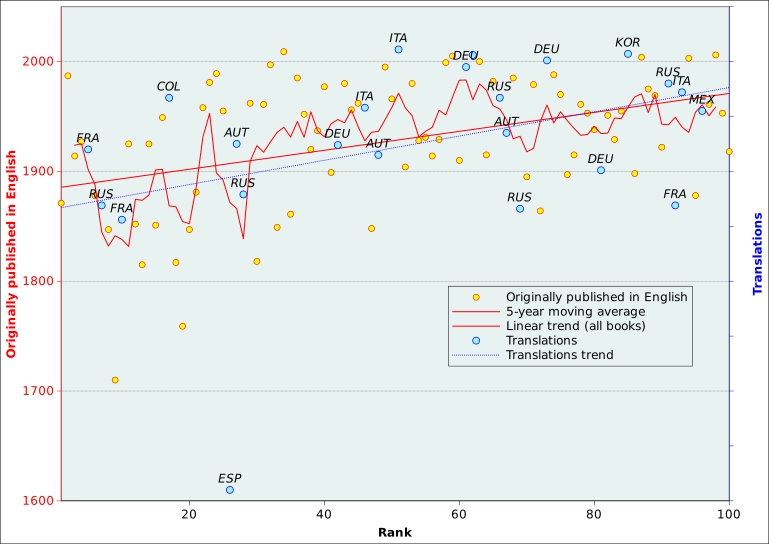
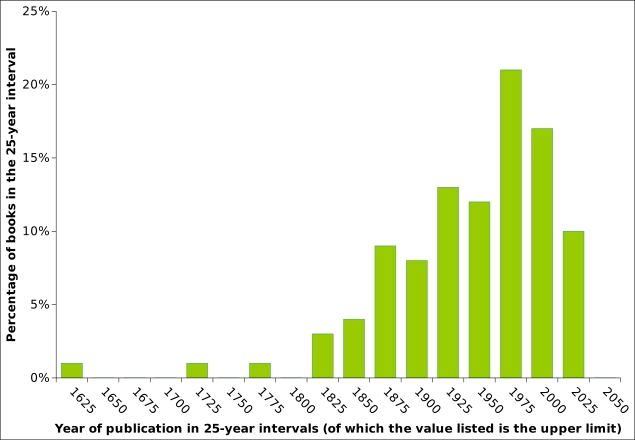
Figure 1 shows the histogramme of the date of the first publication of the top 100. More than 20% were published between 1951 and 1975 and about half appeared between 1926 and 2000. Recent books (published this century) and those published between 1851 and 1900 account for about 10% of the sample.
Figure 2 illustrates the date of publication as a function of the rank. Statistically, it is clear that “the older the better”. The best books (ranked 1 to 20) were published around 1900 or a bit earlier, with ranks above 50 mostly falling in the years 1900 to 2000. No absolute masterpiece seems to have been published after 2000. A very similar trend is observed for translations.
To sum up: I’m left wanting more
The absolute number one in the Guardian’s list is Middlemarch by George Eliot. I haven’t read it, but I’ve just downloaded it for my Kindle for 0.99 €. I am sure I’ll enjoy the book, but I am prepared for some kind of Jane Austen clone. Nice indeed, but not very profound, and rather “provincial”, i.e. with a distinct local flavour. This is also one of the weaknesses of Le Monde’s 100 Books of the Century which are very reflective of the French literary fashions of the 20th century. It is indeed surprising how little overlap there is between the Guardian’s 100 Best novels of all time and Le Monde’s 100 Books of the Century.
The list I somehow expect will be considerably less conventional6 and more international than what I have seen so far. There will be Arabs, and Chinese, maybe a Brazilian and a couple of Kazaks. There will also be less fashion and more depth. Erasmus will be in the list, and a couple of people who don’t shy away from doing some thinking, even if it occurs at the expense of nice storytelling.
Notes
- No small thing! ↩︎
- Ranked from 100 to 1, the best of the best of all time! ↩︎
- The methodology can be improved. I remember a survey conducted by NATO in the early eighties, a time when the opposing tenets of Climate change were Global cooling and Global warming. They stood at 50-50. NATO identified a number of climatologists are asked them to fill in a questionnaire where they were directly and indirectly asked whether they saw themselves as “coolers” or “warmers”. Each respondent was also asked to rank all the other respondents’ competence. Each experts opinion was then weighted by the competence assigned to them by their peers. ↩︎
- Kafka was also a fluent Czech speaker. ↩︎
- While I am ready to admit that Don Quixote is a “great book”, I would put it on my bookshelf next to Rabelais’ Gargantua, von Grimmelshausen’s Simplicius Simplicissimus, Dante, The Decameron and many other early “masterpieces”. You can read it – and indeed, extracts are often read – , especially at school, but I don’t think anyone would have the patience to read all 500 pages of Rabelais’s gargantuan ramblings. Some of it is indeed enjoyable, but at least as much is not! ↩︎
- The Guardian’s list pays a little too much lip service to the classics. I feel that “voters” felt compelled to bow to convention before allowing themselves to follow their hearts. ↩︎
Also try this one: A New Norton Anthology of World Literature Reimagines the Global Literary Tradition
Yesse! Proust, ce serait deux mois de lecture à temps plein 7/7.
J’en ai lu 15.
Un magnifique survol de la littérature mondiale est La Bibliothèque idéale de Pierre Boncenne, préfacé par Bernard Pivot que l’éditeur Gallimard présente comme auteur.
Les auteurs sont en fait deux dizaines d’universitaires, il y a un paquet de chapitres, le roman n’en est qu’une partie, il y a d’ailleurs le roman russe et d’autres chapitres, l’humour (où figure parmi les 10 premiers La philosophie dans le boudoir de Sade – ??), l’histoire etc. Les 10 meilleurs, les 20 suivants, les 19 derniers, ce qui fait 49 élus, “le cinquantième est peut-être chez vous“. Ça date de 1992, compte 995 pages et pèse 1.400 grammes.
There has been intense follow up to the Guardian’s article, including this one. I could not agree more with the comment by Sarah Steiner: I swiftly became disillusioned at the old-fashioned and frankly elitist lens used to judge the “best”.
As to me, I started reading Middlemarch. I stuck with it until the end of Chapter 7, after which I threw in the towel. In the Guardian series “The Books of My Life”, Virginia Evans made me want to read Jhumpa Lahiri’s Interpreter of Maladies. It’s a collection of short stories that all have a nostalgic quality, but clearly not enough to deserve a spot on the Guardian’s dusty list.
That said, I’m grateful to Amazon for charging me only 99 euro cents for Middlemarch.
Here is the latest follow up to The Guardian’s 100 best books, which made quite a splash. The author (Ioan Marc Jones) too likes Middlemarch: I fell in love with a woman called George and thought Middlemarch was magic. Maybe the magic starts at chapter 8? After I finish Jhumpa Lahiri’s Interpreter of Maladies, I promise I’ll give Middlemarch another try!
Jones thinks that Books open our minds and keep them open. They improve our communication, critical thought and intelligence. But, most importantly, novels boost our empathy. They help us to navigate the world with kindness, with compassion. Putting away screens and spending time with a classic, lingering a little on human nature, feels like a valuable pursuit, even if you have to employ a few tricks.
Read this article by Jones. It’s by a person who knows, understands and loves books and reading!
I do not, however, agree with him when he says that In less than a decade, surrounded by screens, I lost my ability to read some of the best books ever written. I find that e-books are perfect. To start with they occupy no shelf-space. When I die, no-one will need to worry about getting rid of them: I’ll take them with me wherever I’ll go! Also, whenever an idea, the name of a place or a person catches my attention, the extra information that will enrich my reading is just a couple of clicks away. Reading on electronic devices vastly expands the reading. Last, but certainly not least; when you e-read, no book is inaccessible, even in the darkest corners of “ethnic Piedmont” where I live.
Les articles se suivent et ne se ressemblent pas. Cette fois-ci, c’est le top 100 des lecteurs. Il n’a pas grand-chose en commun avec la première liste chico-chicosse des élites. Il y a encore un peu de Proust, de Camus et de Austen (c’est mérité!), mais je vois aussi Vonnegut, Eco, Tolkien, le Carré, Frank Herbert, Steinbeck, Amor Towles, Kundera…
Mais – rogntudju de rogntudju! – je revois Middlemarch, cette fois comme N.2. Après avoir investi 0.99€ dans cet immortel chef-d’oeuvre présumé, je suis arrivé au chapitre 7, et puis j’ai abandonné. Je vais m’ y remettre, c’est obligé! Je vois aussi, entre les rangs 80 et 75, cette autre curiosité The Life and Opinions of Tristram Shandy, Gentleman de Laurence Sterne, publié vers 1765 et traduit dès 1777: Vie et opinions de Tristram Shandy, gentilhomme. Ça aussi, il faut que je le lise: je suis trop curieux de voir à quoi ça ressemble!
En attendant, sur la base des très courts commentaires des lecteurs, j’ai téléchargé du côté du N. 70, un Ursula Le Guin (Dispossessed)
DeepL: C’est le seul livre que j’ai lu qui aborde une société anarchiste avec humanité et réalisme. Il traite de physique théorique et d’idéologie politique, mais au fond, c’est l’histoire d’une quête pour trouver sa place dans un monde où l’on ne possède rien. C’est un livre magnifique, radical et intelligent (commentaire de Clare, Toronto, Canada, graduate student studying philosophy).
et aux environs de la 40ème position, The secret history, de Donna Tartt
DeepL: C’est le thriller universitaire sombre par excellence, marqué par une grande profondeur émotionnelle, une atmosphère angoissante et une prose magnifique. L’Histoire secrète tient le lecteur en haleine jusqu’à la toute dernière page, et sa fin est inoubliable. (commentaire de Gabrielle Ulubay, New York, 30, writer).